
 ACE Comms Team
Ten years on, ACE is more than a cluster of successful centres; it is a continental blueprint. Its results-based financing model has linked funding to measurable outcomes and helped turn resources into results from publications and accreditations to internships, patents, and startups. Its partnerships have bridged linguistic and geographic divides to create a network that learns together and moves faster. And its graduates diverse, employable, entrepreneurial are shaping the institutions and industries that will define Africa’s next decade.
In 2025, leaders from government, academia, industry, and development gathered in Accra to mark the tenth anniversary of the Africa Higher Education Centres of Excellence (ACE) program. This was not merely a celebration, but a reckoning with results. Over a decade, ACE has proven that when African universities are empowered to lead, they produce solutions that change lives.
From its earliest days, the program set out to build human capital at scale. Since 2019 alone, more than 90,000 students have been enrolled and trained, the majority at master’s and PhD levels. Women now account for about one-third of graduates, a decisive step toward narrowing gender gaps in fields traditionally dominated by men, including engineering and the broader STEM disciplines. Independent graduate tracer studies tell the rest of the story: within a year of completing their programs, nearly all ACE graduates secure employment, and many already occupy leadership roles in academia, industry, and government. Africa is no longer seen solely as a consumer of knowledge; it is producing the next generation of problem-solvers.
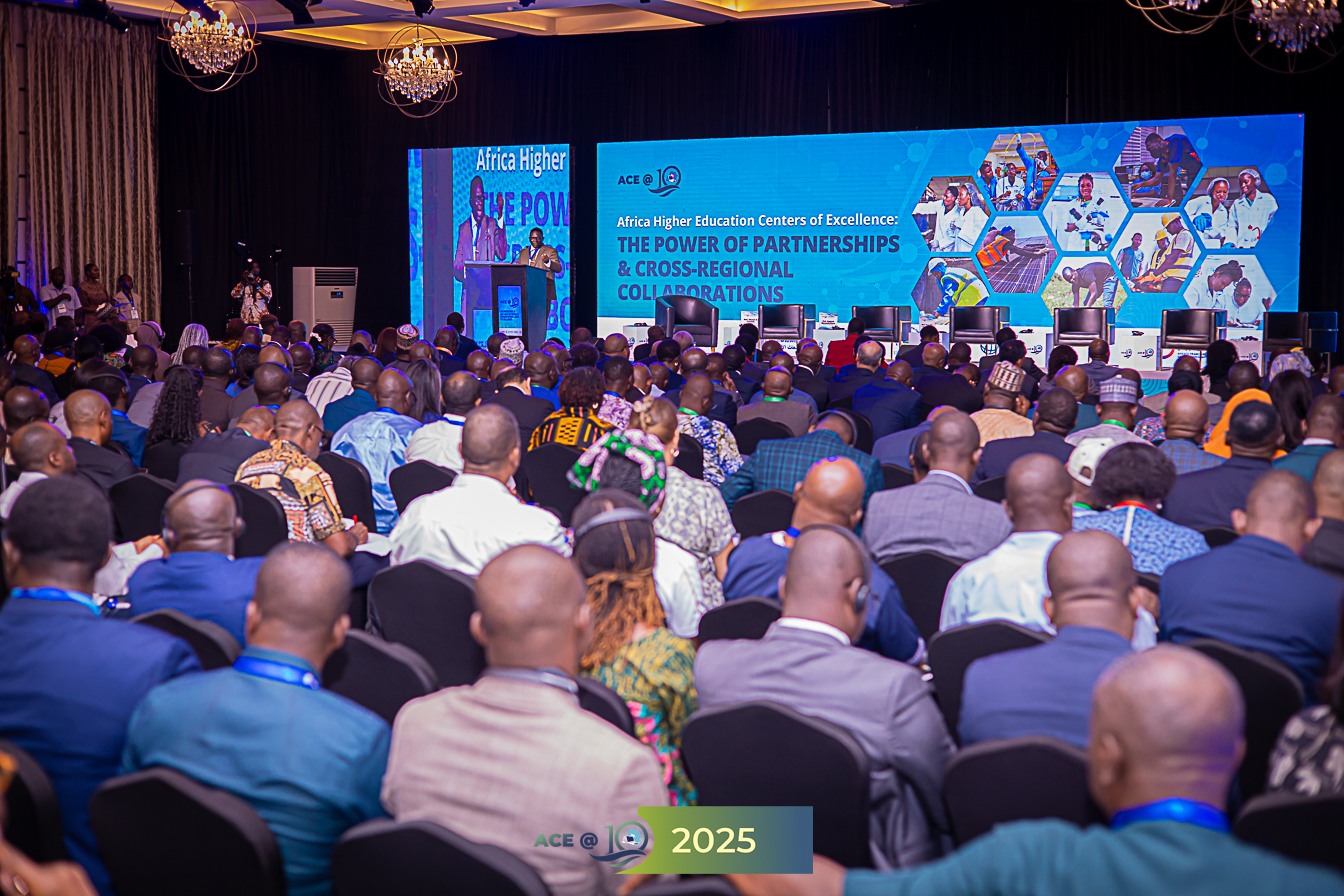
The anniversary showcased how research translates into everyday impact. At the University of Ghana, the West Africa Centre for Crop Improvement (WACCI) has developed 279 improved crop varieties now cultivated by millions of farmers, bolstering food and nutrition security across the region. During the COVID-19 pandemic, the West African Centre for Cell Biology of Infectious Pathogens (WACCBIP) in Ghana and Nigeria’s African Centre of Excellence for Genomics of Infectious Diseases (ACEGID) provided genomic sequencing that gave policymakers real-time data to guide life-saving responses. In Nigeria, the Centre for Food Technology and Research (CEFTER) introduced a cassava shelf-life extension bag that reduces post-harvest losses for smallholder farmers. In Ghana, the Regional Centre for Energy and Environmental Sustainability (RCEES) unveiled clean-mobility prototypes electric-powered motorcycles and bicycles signaling a practical route to greener transport.
Behind these breakthroughs is a culture of partnership that has become ACE’s signature. The program’s centres have built dense networks with ministries, private firms, and global research institutions that accelerate learning and amplify results. Nigeria’s Centre of Excellence for Reproductive Health Innovation (CERHI) worked with health authorities to roll out mHealth tools improving maternal and child care, particularly in rural areas. The Africa Centre of Excellence on Technology-Enhanced Learning (ACETEL) teamed up with Coursera, the EFCC, and the National Center for AI and Robotics to expand digital education and cybersecurity training. Across the network, collaboration has opened doors for more than 18,000 internships, giving students real-world experience while aligning university training with market needs. Quality has risen in parallel: over 130 programs now hold international accreditation and hundreds more have earned national recognition, making ACE institutions industry-aligned, regionally relevant, and globally competitive.
ACE@10 also spotlighted the policy choices that make excellence durable. Ghana’s landmark 2017 commitment of US$156 million to sustain higher education research and the subsequent establishment of the Ghana National Research Fund captures a broader continental trend: governments are institutionalizing research financing, embedding ACE centres in national development strategies, and treating universities as engines of innovation and workforce development. This shift from project to policy is the surest sign that the gains of the past decade will endure.
The celebrations did not sidestep persistent challenges; instead, they convened candid conversations about how to unlock the full potential of Africa’s talent. Gender equity took centre stage. Leaders such as Prof. Emily Akuno and Prof. Folasade Ogunsola argued for reforms that make opportunity real gender-responsive budgeting, campus childcare, robust mentorship, safe learning environments, and community engagement that encourages girls to pursue STEM. Their message was pragmatic and urgent: closing the gender gap is not only a moral imperative, but also essential for the quality and originality of African science.
Entrepreneurship emerged as another throughline connecting classrooms to companies. During the Accra showcase, founders backed by ACE illustrated how research becomes enterprise. In Malawi, Peace Chemis Mnelemba’s Aquaponic for Life converts organic waste into black soldier fly larvae for affordable, sustainable fish feed raising production while cutting waste and training hundreds of farmers who now operate as a cooperative. In Uganda, Jimmy Angupale’s Novel Medicine Formulations transforms locally sourced ghee into high-grade inputs for cosmetics and pharmaceuticals, displacing imports and creating new value chains. These stories are not exceptions; they are proof of an ecosystem where laboratories, incubators, faculty mentors, and industry partners pull in the same direction.
That ecosystem is expanding fast. As Dr. Lord Bessing of Incas Diagnostics put it, true collaboration goes beyond internships to co-created research and shared facilities that prepare innovation-ready graduates. Partnerships like IBM’s multi-country talent pipeline in AI, cloud, and quantum grounded in mentorship and hands-on tools point to what is possible when industry investment meets academic ambition. Still, the message from Accra was clear: collaboration thrives in enabling policy environments. Incentives, IP frameworks, and targeted public funding remain vital to crowd in private capital and translate research into products and services at scale.

Ten years on, ACE is more than a cluster of successful centres; it is a continental blueprint. Its results-based financing model has linked funding to measurable outcomes and helped turn resources into results from publications and accreditations to internships, patents, and startups. Its partnerships have bridged linguistic and geographic divides to create a network that learns together and moves faster. And its graduates diverse, employable, entrepreneurial are shaping the institutions and industries that will define Africa’s next decade.